Before
- An entry writer opens the commercial invoice, the packing list and the client's parts list side by side and checks every line by eye.
- Short shipments, a line that doesn't add up, a blank origin or a brand-new part are often found while keying, or after the truck is at the bridge.
- Questions to the importer, the USMCA certificate or the FDA prior notice are chased one email at a time.
After
- The invoice, packing list and approved classifications are lined up per part: quantity, value, origin, HTS, programs and PGA flags.
- Anything off is flagged; new parts and classification differences are marked needs a look for a licensed broker. Nothing is classified or filed on its own.
- An entry worksheet and one email to the importer with every open question come out ready for review.
Shipment documents (pick a sample, edit it, or paste your own)
Sample shipments:
This page reads text only. In a pilot, PDF and scanned invoices are read first, and any field that can't be read with confidence is shown as "needs a look" instead of being guessed.
Pick a sample shipment or paste your own.
Line-by-line check
Every value shows its source, so anyone can check the check.Entry worksheet, prepared
For broker reviewDuty rates come from the client's approved database (fictional here). Section 301, MPF and fees are confirmed in your entry software.
Email to the importer
Draft · not sentSubject:
Edit freely. In a real build it opens as a draft for your team to send; nothing goes out on its own.
Under the hood: fields read from each document (JSON)
How the check works
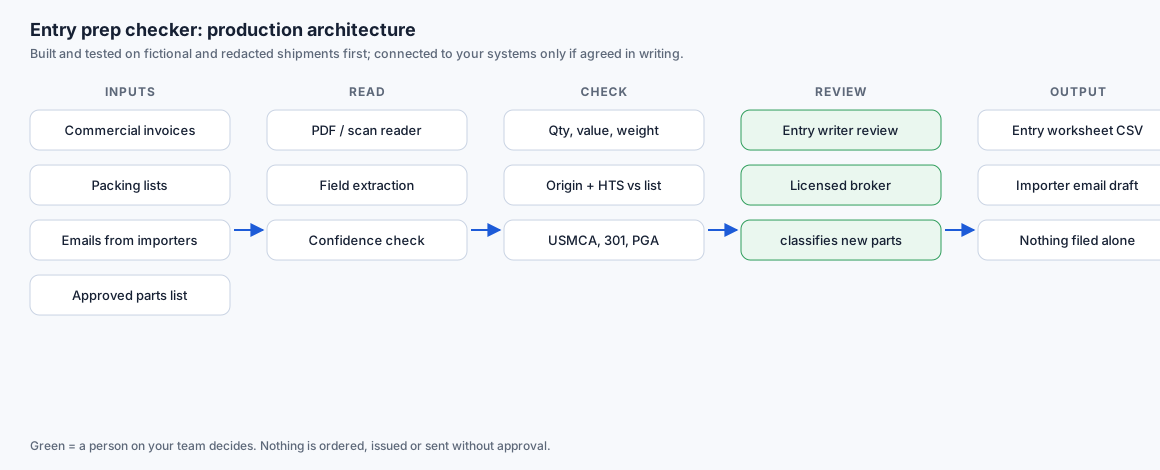
- Read. Invoice, packing list and the client's approved parts list become structured fields: part, quantity, unit price, line total, origin, HTS, cartons and weights. A production build reads PDF and scanned documents too, held to the same fields.
- Check. Invoiced vs packed quantities, quantity × price vs line totals, the invoice total, gross weights, blank origins, supplier HTS vs the approved classification, USMCA certification for North American origin, Section 301 and PGA flags (FDA, USDA, FCC, DOT).
- Hold, don't guess. New parts and classification differences go to a licensed broker; the checker never picks an HTS on its own.
- Prepare. An entry worksheet (CSV) for your entry software and one email to the importer listing every open question.
Production architecture